
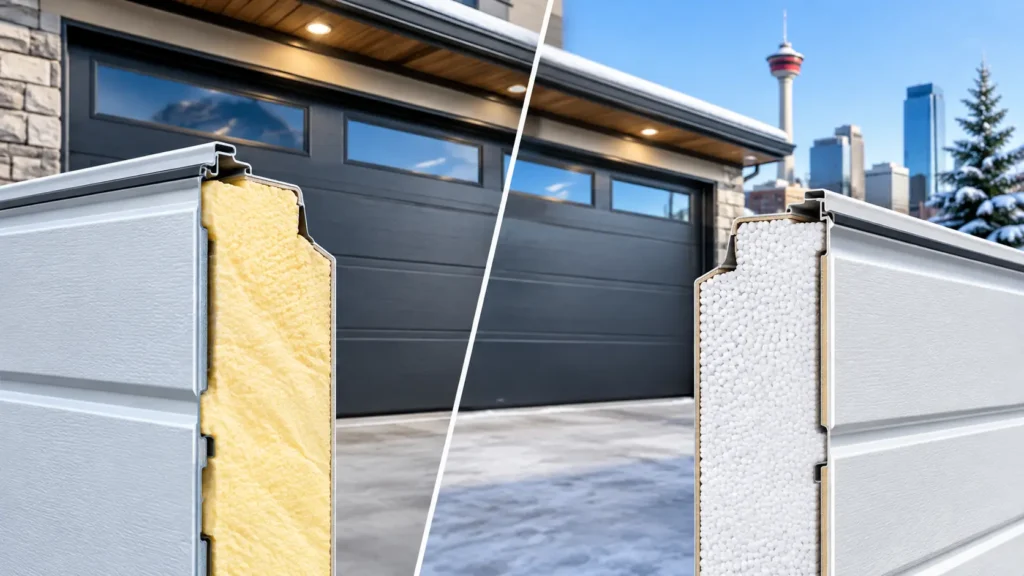
Choosing an insulated garage door in Calgary comes down to two practical questions: what foam fills the panel, and what R-value fits how you use your space? Most confusion starts with sales pitches that make every insulated door sound identical. The core material, panel thickness, and perimeter seals separate a warm, rigid door from an expensive extra.
The short answer
Choose a polyurethane-core door if your garage attaches to your home, holds a heater, or serves as a winter workspace. Pick a polystyrene-core door if you use an unheated garage strictly for parking and want to keep upfront costs lower.
Calgary winters test garage doors with prolonged sub-zero cold snaps and sudden Environment Canada temperature swings during Chinook winds. Understanding how manufacturers rate thermal resistance helps you avoid paying for insulation your space does not need.
What R-value means for Calgary garages
R-value measures how well a material resists conductive heat flow, so a higher number slows heat transfer better than a lower number. An R-16 panel resists heat loss significantly better than an R-12 panel of the same construction.
In winter, higher thermal resistance keeps heat inside an attached or heated garage longer. In summer, that same barrier slows afternoon heat from baking the garage interior.
The Door & Access Systems Manufacturers Association (DASMA) sets industry standards like TDS-163 for calculating door section R-value and ANSI/DASMA 105 for testing whole-door U-factor. Because R-value only measures resistance through the panel itself, air leaks around the frame can still chill your garage. Before comparing door ratings, examine how the two main foam cores differ inside the steel skins.
Polyurethane vs. polystyrene foam cores
Polyurethane is a liquid foam that expands and bonds directly to both steel skins, while polystyrene (EPS) consists of rigid foam sheets cut to fit inside the panel. That manufacturing difference changes thermal efficiency, panel stiffness, and thickness.
| Feature | Polystyrene (EPS) | Polyurethane |
|---|---|---|
| Construction | Rigid foam boards cut and fitted between steel skins | Liquid foam injected between steel skins, expanding to fill every gap |
| Insulating Power | Lower R-value per inch (roughly half that of polyurethane) | Higher R-value per inch due to dense closed-cell structure |
| Panel Thickness | Requires a thicker panel (e.g., 3 inches) to reach R-16 | Reaches R-12 to R-18 in slimmer 1-3/8 to 2-inch profiles |
| Structural Strength | Board sits inside the cavity without bonding to steel | Bonds to both steel skins, stiffening the panel against dents |
| Cost Positioning | Lower upfront purchase price | Higher upfront cost for stronger thermal and structural performance |
| Best Calgary Fit | Detached garages, cold parking, budget-focused upgrades | Attached garages, heated spaces, workshops, rooms above garage |
Why bonded polyurethane stiffens the door
Because injected polyurethane adheres directly to the front and back steel faces, it turns the panel into a single rigid composite unit. That bond reduces hollow rattling when the door cycles and helps the steel resist everyday bumps from bikes, shovels, and car doors.
When polystyrene remains a smart choice
Expanded polystyrene still cuts heat transfer and dampens outside street noise far better than an uninsulated single-layer steel door. For a detached garage where you only park a vehicle and store seasonal gear, a polystyrene door delivers practical value without stretching your budget.
Once you pick the right foam core, match the panel’s R-value to how you actually use the space every day.
Which R-value does your garage need?
Match your R-value to your garage layout: aim for R-10 to R-12 on attached parking garages, and step up to R-16 or R-18 if you heat the space or share a wall with a bedroom.
| Garage Type & Daily Use | Recommended R-Value Range | Practical Calgary Reason |
|---|---|---|
| Detached, unheated parking | Non-insulated to R-9 | Blocks wind and snow while keeping replacement costs low |
| Attached, unheated parking | R-10 to R-12 | Slows cold air from pulling heat out of adjacent house walls |
| Heated garage (8 to 10 °C) | R-12 to R-16 | Reduces furnace or unit-heater runtime during deep winter cold snaps |
| Workshop, gym, or room above | R-16 to R-18+ | Stabilizes indoor comfort during -25 °C freezes and Chinook swings |
A quick Calgary homeowner checklist
- Attached walls: Heat escaping through an uninsulated garage pulls warmth from adjacent mudrooms, kitchens, and bedrooms.
- Heated spaces: Even a small space heater works harder behind an R-6 door than behind an R-12 or R-16 polyurethane panel.
- Living space overhead: Bedrooms or bonus rooms above a garage feel noticeably warmer on cold mornings when the door below rates R-16 or higher.
- Cold parking only: If you never heat the garage, save money on the core and invest in durable perimeter weatherstripping instead.
Even the highest R-value on a brochure cannot keep a garage warm if cold air slips around the edges of the door.
Why R-value is only part of the story
A high R-value panel still loses heat fast if gaps, worn seals, or metal-to-metal contact let freezing air bypass the foam. Natural Resources Canada’s Keeping the Heat In guide emphasizes that effective insulation always pairs thermal resistance with a continuous air barrier.
- Flexible bottom seal: Choose an EPDM or cold-rated vinyl astragal that stays pliable at -25 °C rather than cracking on frozen concrete.
- Between-section joints: Tongue-and-groove panel joints with internal foam gaskets block wind from whistling between horizontal sections.
- Perimeter weatherstripping: Vinyl-finned stop molding along the jambs and header seals the gap between the door face and the wood frame.
- Thermal breaks: A non-conductive vinyl or polymer barrier between the inner and outer steel skins stops cold from bridging straight through the metal.
- Panel vs. whole-door ratings: Manufacturers calculate brochure R-values at the center of the foam section, whereas whole-door U-factor testing under ANSI/DASMA 105 accounts for joints and hardware.
If your current door already has foam insulation but still feels drafty, worn seals are often the real culprit. Read our guide on weatherproofing a garage door for Calgary winters to inspect and replace failing weatherstripping first.
Steel gauge and surface durability
Outer steel thickness also shapes how well a door holds up in daily use. Look for heavy-duty 24-gauge steel skins when you want stronger dent resistance against hail, hockey pucks, and busy family driveways. Knowing how cores, seals, and steel gauge work together makes it much easier to compare actual door lines.
What the doors we offer are made of
We carry polystyrene and polyurethane door lines built for Canadian weather so you can match exact specs to your garage. Here is how our current product lines compare.
- Classic series (Polystyrene EPS): Our Classic garage doors use Therma-Tech expanded polystyrene cores in three thicknesses: 1.5-inch Standard (R-9), 2-inch Upgraded (R-10.4), and 3-inch Superior (R-16).
- Northland series (Polyurethane): Built in Canada for cold climates, our Northland R12 packs R-12 into a 1-3/8-inch polyurethane panel, while our Northland R18 delivers R-18 in a 2-inch polyurethane profile.
- Premium and Designer series (Custom): Our Premium doors include architectural styles like the Shadow series (R-10.4) and Contemporary Planks (R-10.29 to R-17.54). Call us for current insulation specs on our custom Designer series.
Notice the thickness trade-off in those numbers: the Classic Superior door needs 3 inches of polystyrene to hit R-16, while the Northland R18 reaches R-18 in just 2 inches of polyurethane. Explore our full garage door series overview to compare styles, and ask our team to confirm current model-year specs before ordering. Once you see the specs side by side, a six-step checklist narrows down your final choice.
A simple way to choose your door
Follow these six steps in order to pick the right insulated garage door without overpaying for unused capacity.
- Define your garage use: Separate cold vehicle parking from heated workshops, gyms, or rooms attached to living space.
- Pick your target R-value: Use R-10 to R-12 for attached parking, or R-16 to R-18 for heated spaces.
- Select the foam core: Choose polystyrene for budget-friendly detached garages, or polyurethane for thinner, stiffer, higher-R panels.
- Verify cold-weather seals: Confirm the door includes an EPDM bottom seal, perimeter weatherstripping, and section thermal breaks.
- Check your opener capacity: Heavier insulated steel doors require properly balanced torsion springs and an opener rated for the door’s total weight.
- Review warranty coverage: Read our warranty page to see what our coverage includes for new door sections, hardware, and installation.
With your priorities clear, getting an accurate local measurement and quote takes just one quick conversation.
Frequently Asked Questions
Is an insulated garage door worth it in Calgary?
Yes, an insulated door pays off whenever your garage attaches to your home, holds a heater, or serves as a workspace. It slows winter heat loss, reduces drafts against shared interior walls, and keeps door operation quieter. For a detached, unheated parking garage, a lightly insulated door usually provides enough protection.
What R-value should a Calgary garage door have?
Aim for R-10 to R-12 for an attached, unheated garage, and R-12 to R-16 if you heat the space to 8 to 10 °C. Choose R-16 to R-18 for a year-round workshop, home gym, or garage with a bedroom directly above it.
Is polyurethane better than polystyrene for a garage door?
Polyurethane delivers roughly twice the insulating power per inch of polystyrene and bonds directly to the steel skins, making the panel stiffer and more dent-resistant. Polystyrene remains a practical, lower-cost option when you only need basic insulation for an unheated parking garage.
Does a higher R-value always mean a warmer garage?
No. Air leaks around worn bottom seals, unsealed panel joints, and missing perimeter weatherstripping can undo a high R-value rating. Pair a well-insulated panel with cold-flexible weatherstripping and a thermal break for real winter comfort.
Can I add insulation to a garage door I already have?
Aftermarket foam kits exist for some single-layer doors, but adding weight changes how the torsion springs balance the door and can strain your opener. Have a trained technician inspect your springs and opener before adding any retrofit kit.
How much does an insulated garage door cost in Calgary?
Final pricing depends on the door size, series, R-value, window inserts, and whether you need a new opener. Call Calgary Garage Doors Inc. at 403-415-4111 for a free, accurate estimate tailored to your opening.