
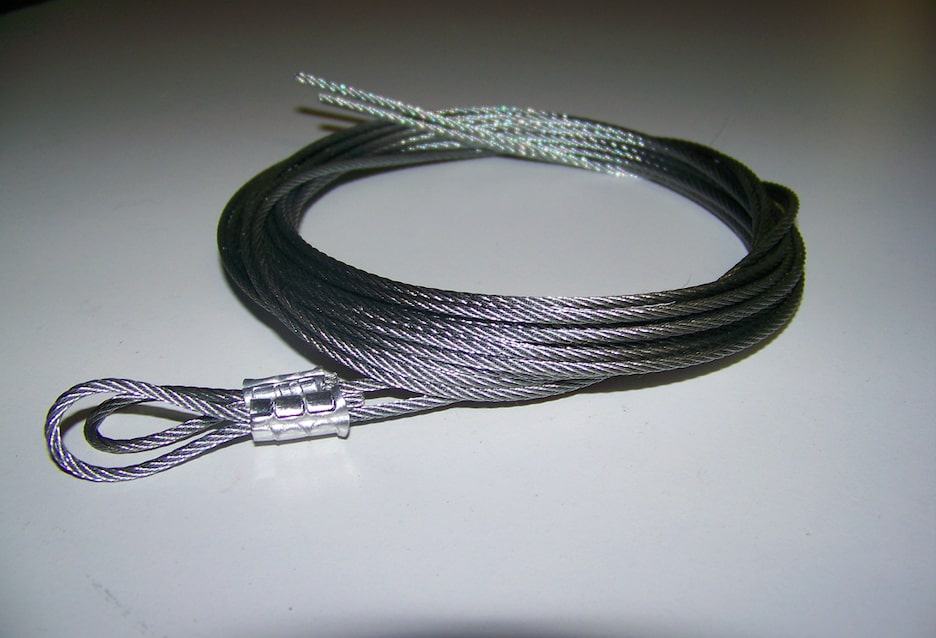
Garage door lifting cables are the most corrosion-exposed component on a Calgary door system. Every vehicle entering your garage tracks in magnesium chloride, calcium chloride, and sodium chloride from treated roads – and that chemical mixture splashes directly onto the lower cable sections on every parking event. In Calgary, cables corrode from the outside in across multiple winters before a strand snaps, usually without visible warning until the failure is imminent.
This guide covers how cables work, how long they last in Calgary’s specific environment, what the warning signs look like at each failure stage, and the clear line between homeowner maintenance and professional repair.
How Garage Door Lifting Cables Work and Why They Fail
Garage door lifting cables are woven steel cables that run from a bottom bracket at the lower corner of the door, up through a cable drum mounted on the torsion shaft above the door opening. When the torsion spring unwinds, it rotates the shaft, which rotates the drum, which winds the cable and lifts the door. The cables do not carry the door’s full weight independently – they work in parallel with the torsion springs. But when a cable snaps, the door loses support on that side and drops immediately.
Cable failure in Calgary is almost always corrosion-driven rather than mechanical wear. The failure mechanism is progressive strand failure: chloride ions from road salt attack the outer strands of the woven cable first, creating microscopic pitting that accelerates fatigue cracking under cyclic load. Strand by strand, the cable loses tensile cross-section. From the outside, the cable appears intact until the remaining strands can no longer carry the load and the cable snaps.
This is why most Calgary homeowners report no warning before a cable fails. The warning signs exist – but they are subtle and require knowing what to look for.
How Long Do Garage Door Cables Last in Calgary?
Under normal operating conditions, garage door lifting cables are rated for approximately 10,000 cycles (Door and Access Systems Manufacturers Association, DASMA standard). At two open-close cycles per day, that is roughly 13 years of service life. Calgary’s road salt environment compresses that significantly.
On unprotected cables in a Calgary garage with regular vehicle use, corrosion-accelerated strand failure typically appears between 7 and 9 years – two to four years ahead of the DASMA baseline. Cables on garage doors that are used three or more times per day, or where the garage floor is not regularly washed to remove salt residue, can show advanced corrosion in five to six years.
Three factors accelerate cable degradation in Calgary specifically:
- Road treatment chemicals: Calgary uses magnesium chloride as a primary anti-icing agent from October through April. Magnesium chloride is more corrosive to steel than sodium chloride (rock salt) and remains chemically active at temperatures as low as -15°C – meaning it continues attacking cable strands during the coldest months when the damage is least visible.
- Freeze-thaw cycling: Calgary averages 30-40 freeze-thaw events per winter driven by Chinook winds. Each cycle introduces fresh meltwater carrying dissolved chlorides into cable strands, then refreezes it, expanding the micro-pitting created by the previous corrosion cycle.
- Unheated garages: An unheated detached or attached garage without insulation keeps the cable hardware at ambient outdoor temperatures through winter. Condensation on cold metal surfaces when a warm vehicle parks inside deposits chloride residue directly onto cable strands with no evaporation buffer.
Age benchmark: If your garage door cables are over 8 years old and your garage is used daily in a Calgary winter, book a cable inspection before the next cold season. The cost of a cable replacement ($150-$280 per pair installed) is substantially lower than an emergency repair call following a cable snap, which typically also damages the bottom bracket, sometimes the panel, and occasionally the opener drive system.
Warning Signs Your Garage Door Cables Need Attention
Most cable warning signs are visible during a routine inspection – if you know where to look and what the failure stages look like. Inspect both cables monthly during winter and quarterly during the rest of the year. The inspection takes two minutes and requires no tools.
| Warning Sign | Action Required | Urgency |
| Visible strand fraying | Stop operating the door. Call for cable repair today. | STOP – Immediate |
| Rust streaks on cable | Book inspection within the week. Salt corrosion is active. | STOP – Immediate |
| Slack or looping cable | Stop operating. One side has lost tension – door can drop. | STOP – Immediate |
| Uneven door travel | Inspect cable drums and bottom brackets. Book service. | WATCH – Book within 2 weeks |
| Bottom corner gap when closed | Cable is longer on one side. Tension is off. Book service. | WATCH – Book within 2 weeks |
| Grinding or popping sound | Could be cable drum or roller. Inspect both. Monitor closely. | WATCH – Book within 2 weeks |
| Door jerks during travel | Cable slipping on drum or frayed section catching bracket. | WATCH – Book within 2 weeks |
The One Sign That Means Stop Operating the Door Immediately
A slack or looping cable on one side of the door means that cable has lost tension. This happens either because the cable has snapped internally (strands failed but the outer jacket held temporarily), because the cable has jumped off the drum, or because the bottom bracket that anchors the cable to the door has cracked or separated.
A door with a slack cable is structurally unsupported on that side. If the opener activates, the door will travel unevenly and can jam in the track, bend the bottom panel, or drop fully if the remaining cable gives way. Do not activate the opener. Disconnect it using the emergency release cord and call for garage door cable repair in Calgary before operating the door again.
What You Can Maintain Yourself
Three cable maintenance tasks are safe and practical for homeowners: visual inspection, salt residue washing, and cable drum area lubrication. None of these require tools or involve touching the cables under tension.
Monthly Visual Inspection
Stand inside the garage with the door closed and examine both cables from the floor to the cable drum. You are looking for:
- Rust streaks or dark discolouration along the cable length
- Individual strands visible outside the main cable bundle – this is fraying
- Any section where the cable appears kinked, flattened, or off-alignment
- The cable drum: rust on the drum face or cable sitting unevenly in the drum groove
- The bottom bracket where the cable attaches to the door corner: cracks, bending, or looseness
Do this inspection with the door closed and the opener in normal mode – do not disconnect anything. You are doing a visual check only, not a functional test.
Salt Residue Wash
Twice during winter – once in December and once in February – wash the garage floor along the door travel path, the lower vertical track sections, and the hardware at the bottom of the door with warm water. This removes accumulated chloride residue before it penetrates deeper into cable strands and track hardware.
Use warm water and mild detergent. Do not use a pressure washer directed at cable hardware – high-pressure water forces water into strand interstices where it cannot easily evaporate. Allow everything to dry before closing the garage.
Cable Drum Area Lubrication
Apply a light coat of white lithium grease to the cable drum and the cable itself where it wraps onto the drum. Do not spray lubricant along the full cable length – the middle sections of the cable do not need lubrication and excess product attracts grit.
Use white lithium grease or silicone spray only. Do not use WD-40 on cables. WD-40 is a solvent, not a lubricant – it strips existing protection, attracts road salt, and leaves the cable surface drier and more corrosion-exposed within days of application.
What Requires a Professional
Cables are under the same spring tension as the torsion spring system – typically 100 to 200 foot-pounds of stored energy depending on door weight. Any work that involves touching, adjusting, or replacing cables under tension is a professional task. This boundary is non-negotiable:
- Cable replacement: Both cables must be replaced simultaneously. Replacing only the damaged cable leaves the intact cable overloaded and typically at a similar corrosion stage. Replacing one cable and leaving the other means the same emergency call in three to six months.
- Cable tension adjustment: Cable tension is set by the torsion spring winding. Adjusting cable tension without adjusting spring tension is not possible. Any imbalance in cable tension shows up as a door that travels unevenly or fails the balance test. This requires garage door spring replacement or adjustment in Calgary as part of the same service.
- Bottom bracket replacement: The bottom bracket that anchors the cable to the door corner is under the full tension load of the torsion spring system. It cannot be safely removed or replaced while the spring is wound. A cracked or bent bottom bracket is a professional repair.
- Cable drum replacement: Cable drums are press-fit or set-screwed onto the torsion shaft. Removing them requires releasing spring tension first. Attempting this without releasing spring tension causes the shaft to spin uncontrolled.
- Any frayed cable: A cable with visible fraying has compromised strand integrity. It should not be operated under load. Stop using the door and call for garage door cable repair in Calgary.
How Often to Schedule Professional Cable Maintenance in Calgary
Calgary’s salt season runs October through April – seven months of active chloride exposure per year. That rate of environmental exposure warrants a professional cable inspection twice annually: once in October before sustained cold, and once in April after the last hard freeze.
These inspections align with the broader pre-season garage door performance check that covers springs, rollers, tracks, seals, and opener force calibration. A cable inspection as part of a full tune-up costs no more than a standalone cable inspection and catches correlated wear across the whole system – a cable that is corroding will almost always have rollers and lower track hardware at the same corrosion stage.
Accelerate to quarterly inspections if any of the following apply:
- Cables are over 7 years old
- Garage is used three or more times daily
- Garage floor is not regularly washed during winter
- Vehicle regularly parks with significant snow or slush on the undercarriage
- Previous cable replacement was single-cable only (other cable is at risk)
If a cable snaps without a prior inspection having been scheduled, that is an emergency garage door repair situation – the door cannot be safely operated and the opener should be disconnected immediately. Calgary Garage Door Fix carries cable replacement parts on every service vehicle and handles most residential cable replacements same-day.
Frequently Asked Questions
How do I know if my garage door cable is fraying?
Stand inside the garage with the door closed and look at both cables from the floor to the drum. Fraying appears as individual wire strands that have separated from the main cable bundle – they look like small wire hairs protruding from the cable surface. You may also see rust-coloured discolouration or dark streaking at the frayed area. Any visible fraying means the cable should be replaced before the next operation cycle.
Can I replace garage door cables myself?
No. Lifting cables are connected to the bottom bracket and the cable drum, both of which are under the full tension load of the torsion spring system. Disconnecting a cable without first releasing spring tension causes the door to drop suddenly and the torsion shaft to spin. Either outcome creates a serious injury risk. Cable replacement requires releasing spring tension with specialised winding bars – a professional task.
How much does garage door cable replacement cost in Calgary?
Cable replacement in Calgary typically costs $150-$280 installed for both cables on a standard residential door. If the bottom bracket is also damaged, add $50-$120 per bracket. If the cable drum needs replacement, add $80-$150. Calgary Garage Door Fix provides upfront quotes before beginning any work – call 403-415-4111. Always replace both cables simultaneously regardless of which one failed.
What happens if I keep using my garage door with a frayed cable?
A frayed cable has a reduced tensile cross-section. Each operation cycle loads the remaining intact strands beyond their design capacity, accelerating the failure rate. The cable will snap – the only question is when. When it does, that side of the door loses support and drops immediately, often damaging the bottom panel, bending the track, and jamming the opener. The repair cost after a snap is consistently higher than the cost of replacing a cable that was caught at the fraying stage.
Do both garage door cables need to be replaced at the same time?
Yes. When one cable fails or shows advanced corrosion in Calgary, the other cable has experienced the same road salt exposure across the same number of operating cycles. Replacing only the failed cable leaves the other operating at or near its failure threshold. Within one to three seasons, the second cable fails. The labour cost of two separate cable replacements is higher than doing both in one visit, and the second failure typically happens at a worse time.

Roopinder Singh China is the owner of Calgary Garage Doors Inc., a Calgary-based garage door company established in 2016. He oversees the company’s garage door services and brings practical business and industry experience to the information published on the website.
Experience: 10+ years
Expertise: Garage Door Repair · Installation · Garage Door Openers · Door Service