
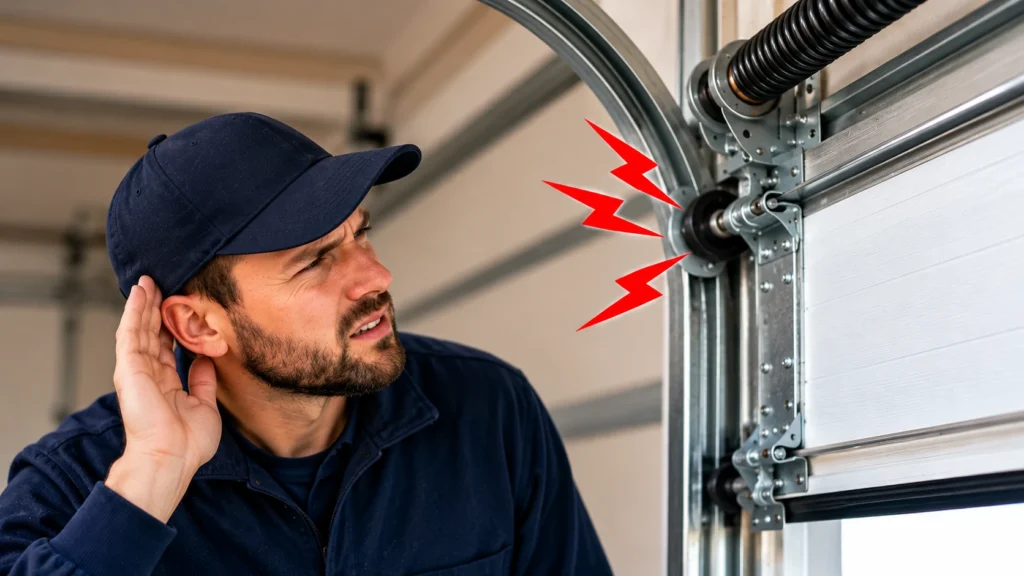
Most garage door noise comes from friction, wear or loose hardware, and the sound usually points to the cause: squeals suggest dry hinges or rollers, grinding or dragging suggests worn rollers or bearings, pops and snaps suggest a flexing or cracked panel, and rattles suggest loose hardware or track alignment. You can safely lubricate hinges, rollers and tracks and tighten loose hardware. Leave springs, cables and bottom brackets to a trained technician, and
Start here: what is safe to check
Before you listen for clues, follow a few basic safety precautions:
- Look, do not touch, the high-tension parts. Springs, cables, pulleys, and the brackets at the bottom corners are under extreme tension. According to the DASMA garage door safety guidelines, bottom brackets should only be adjusted or loosened by a trained door systems technician, and frayed cables should be replaced by a qualified professional.
- Do a visual check with the door closed. The garage door care and maintenance guidance from the Door & Access Systems Manufacturers Association recommends checking springs, cables, rollers, and pulleys for visible wear or damage, including frayed cables.
- Run a balance test. Disconnect the opener and carefully lift the door by hand. A properly balanced door should move smoothly with little resistance and remain open when fully raised. If it feels unusually heavy or will not stay open, have a technician inspect it.
- Keep everyone clear while checking the door. Tell everyone in the household not to operate the garage door while you are inspecting or working around it.
Sound by sound: what it means and what to do
[IMAGE: A garage door track with rollers and hinges labelled | alt: garage door rollers hinges and track that can cause noise]
The type of noise your garage door makes can help identify the underlying problem. Use the table below for a quick diagnosis, then review the sections that follow for the likely cause, what you can safely check, and when to call a garage door technician.
| Sound | Most Likely Cause | Safe to Try | Call a Technician If |
|---|---|---|---|
| Squeal or screech | Dry hinges or rollers, lack of lubrication | Lubricate hinges, rollers and track | It returns within weeks |
| Grinding or dragging | Rollers not spinning, rollers dragging in the track, failing bearings | Stop and look for drag marks on the track | Any time |
| Pop or snap | Weak or cracked panels, sections flexing, failing struts | Look for cracks or bowing | Any time you see damage |
| Rattle or vibration | Loose hardware, house settling, track alignment | Check and tighten accessible hardware | The track looks misaligned |
| Loud bang | A broken spring or a part that has let go | Do not use the door | Immediately |
| Motor hum with no movement | Opener drive problem | Do not keep pressing the button | See the opener section |
These common garage door noises can indicate problems with rollers, hinges, bearings, panels, springs, hardware, tracks, or the garage door opener.
If you hear grinding or dragging, check for visible marks on the track and avoid repeatedly operating the door. If the door has moved out of the track, our guide to how to fix a garage door that’s off track explains the warning signs and what homeowners should avoid doing themselves.
For a loud bang, broken spring, damaged cable, or other high-tension component, stop using the garage door and have it inspected by a qualified garage door technician.
Squeal or screech
The problem: A high-pitched squeak or screech when the garage door opens or closes.
The likely cause: Dry hinges, rollers, or other moving parts are common causes. Squeaking springs can also be normal, according to DASMA, but they should never be adjusted or handled directly.
What to do: With the door closed, apply a small amount of garage door lubricant to the hinges, roller stems, and other recommended moving parts. Use a lubricant designed for garage doors rather than a general-purpose spray. Regular lubrication can help reduce friction and garage door noise.
Watch for: If the squealing returns within a few weeks, lubrication may only be masking a worn or failing component. At that point, the door should be inspected by a garage door technician. For a more complete maintenance routine, see our guide to garage door tune-up.
DASMA recommends using spray-on lubricant for squeaking springs but cautions homeowners not to touch, adjust, or wind the springs themselves.
Grinding or dragging
The problem: A rough, scraping, or dragging sound as the garage door opens or closes.
The likely cause: The rollers may not be spinning properly, may be dragging against the track, or may have worn bearings. Visible drag marks on the track are a warning sign.
Why it matters: A seized bearing or failing roller can affect how the door moves and may cause it to twist or come out of the track. These problems can become more serious when the door is open.
What to do: Stop operating the door and have it inspected. If the door has already come off the track, our guide on how to fix a garage door that’s off track explains what homeowners can safely check and what should be left to a technician. If the grinding or dragging continues, contact Calgary Garage Doors for garage door repair to have the problem diagnosed and repaired.
A small upgrade worth knowing about: Nylon garage door rollers are generally quieter than steel rollers. If worn rollers are contributing to the noise, ask your technician whether nylon rollers are suitable for your door.
Pop or snap
The problem: A sharp crack or pop as the garage door opens or closes.
The likely cause: Weak or cracked panels, door sections flexing under load, or missing or failing struts can cause popping or snapping sounds.
What to do: With the door closed, look for cracks, bowing, or visible damage around the panels and hinges. Do not try to straighten or reinforce a damaged panel yourself. If you find damage, our guide to garage door panel replacement in Calgary explains the available options. If the popping continues or you find visible panel damage, contact Calgary Garage Doors for garage door repair to have the door inspected and repaired.
Rattle or vibration
The problem: A buzzing or rattling sound that shakes through the garage door or garage walls.
The likely cause: Loose hardware, house settling, or garage door track alignment problems can cause vibration and rattling.
What to do: With the door closed and everyone clear, check accessible bolts on the hinges and track brackets and tighten them if necessary. Do not touch the bottom brackets. If the track looks bent or out of alignment, stop operating the door and have it inspected.
A loud bang
The problem: A loud bang followed by a garage door that feels unusually heavy or will not open.
The likely cause: A broken garage door spring is a common cause. Other high-tension components can also fail suddenly.
What to do: Stop using the door and do not force it open. If the door is partly open, do not pull the emergency release, as the door may be extremely heavy without spring support. For the warning signs of a broken spring, see our guide on how to know when your garage door springs need repair.
DASMA warns that garage door springs operate under high tension and can cause serious injury if improperly handled. If you suspect a broken spring, schedule garage door spring replacement or request emergency garage door repair from a qualified technician.
Quiet a noisy garage door: the quick lubrication routine
If your garage door makes a squeal or dry-sounding creak, lubrication may help reduce friction and noise. This is a relatively simple maintenance task:
- Close the door and make sure no one will operate it while you work.
- Wipe visible dirt and old grease from the hinges and other accessible moving parts.
- Apply a small amount of garage door lubricant to the hinges, roller stems, and other recommended points.
- Open and close the door by hand a few times to distribute the lubricant.
- Wipe away excess lubricant so it does not collect dust.
- Repeat the lubrication routine about twice a year.
About squeaky springs: DASMA says squeaking springs can be normal and suggests trying a spray-on lubricant before calling a professional. Apply lubricant from a safe distance and never touch, adjust, or wind the spring itself.
For a broader maintenance checklist, see our garage door tune-up guide to learn what a complete garage door service covers.
The noises you should not ignore
[IMAGE: A worn roller and scuffed track on a garage door | alt: worn garage door roller that makes a grinding noise]
Stop using the garage door and call for professional service if you notice any of these warning signs:
- Grinding, scraping, or dragging sounds, especially when you see marks on the track.
- A loud bang followed by a door that feels unusually heavy or will not open.
- A door that looks crooked, hangs unevenly, or has come out of the track.
- A cable that appears frayed, loose, or off its drum.
- Pops or snaps that are becoming louder or more frequent.
These sounds can indicate increasing friction, worn components, or a developing mechanical failure. A minor noise may sometimes be resolved with routine maintenance, but continuing to operate a door with a damaged roller, cable, spring, or track can turn a small problem into a more serious repair.
If you notice any of these warning signs, stop operating the door and have it inspected by a qualified garage door technician.
Is it the door or the opener?
[IMAGE: A ceiling-mounted garage door opener motor head and rail | alt: garage door opener motor head and rail]
Not every garage door noise comes from the door itself. The garage door opener, trolley, drive gear, or rail can also create unusual sounds. These clues can help you narrow down the source:
- The motor hums but the door does not move. Do not keep pressing the button. The problem could involve the opener drive, trolley, or a door that is stuck or binding. If you are unable to get your vehicle out, see our guide on what to do when your car is stuck in the garage.
- You hear grinding from the motor head. A stripped drive gear can cause the opener motor to run or hum while the trolley does not move. Learn more about garage door opener repair costs in Calgary and what different opener problems may require.
- The noise only occurs when the opener runs. Disconnect the opener and carefully move the door by hand. If the door moves smoothly and quietly by hand but becomes noisy when the opener is engaged, the opener is more likely to be the source. If the door remains noisy by hand, the problem may be with the door hardware.
Cold Calgary weather can also make existing garage door problems more noticeable. A door that suddenly feels heavier, noisier, or harder to operate in winter should be inspected rather than repeatedly forced. See our guide on why a garage door can feel heavier in late winter for more detail.
FAQs
Why is my garage door suddenly so loud?
A sudden increase in garage door noise usually means a component has become dry, loose, worn, or damaged. Squealing often comes from dry hinges or rollers, while rattling can indicate loose hardware and grinding may point to worn rollers or bearings. If the noise is new, rough, or getting worse, stop using the door and have it inspected.
Is a squeaky garage door dangerous?
Not necessarily. DASMA notes that squeaking springs can be normal, but persistent noise should not be ignored. If the squeak returns within a few weeks or is accompanied by grinding, a heavy door, or uneven movement, have the door inspected by a technician.
Can I use WD-40 on my garage door?
It is better to use a lubricant specifically designed for garage doors. Apply a small amount to the recommended moving parts, such as hinges and roller stems, and wipe away excess lubricant. Avoid lubricating parts that should not be handled, including garage door springs and bottom brackets.
How often should I lubricate my garage door?
The doors.org maintenance guidance recommends lubricating hinges, rollers, and tracks twice a year. If the noise returns much sooner, lubrication may only be masking a worn or failing component. A recurring squeak should be inspected rather than repeatedly lubricated.
Which garage door noises mean I should stop using the door?
Stop using the garage door if you hear grinding or dragging, a loud bang followed by a heavy door, or notice a crooked door or frayed cable. These signs can indicate failing rollers, a broken spring, damaged cables, or another mechanical problem that could become more serious if the door continues to operate.

Roopinder Singh China is the owner of Calgary Garage Doors Inc., a Calgary-based garage door company established in 2016. He oversees the company’s garage door services and brings practical business and industry experience to the information published on the website.
Experience: 10+ years
Expertise: Garage Door Repair · Installation · Garage Door Openers · Door Service